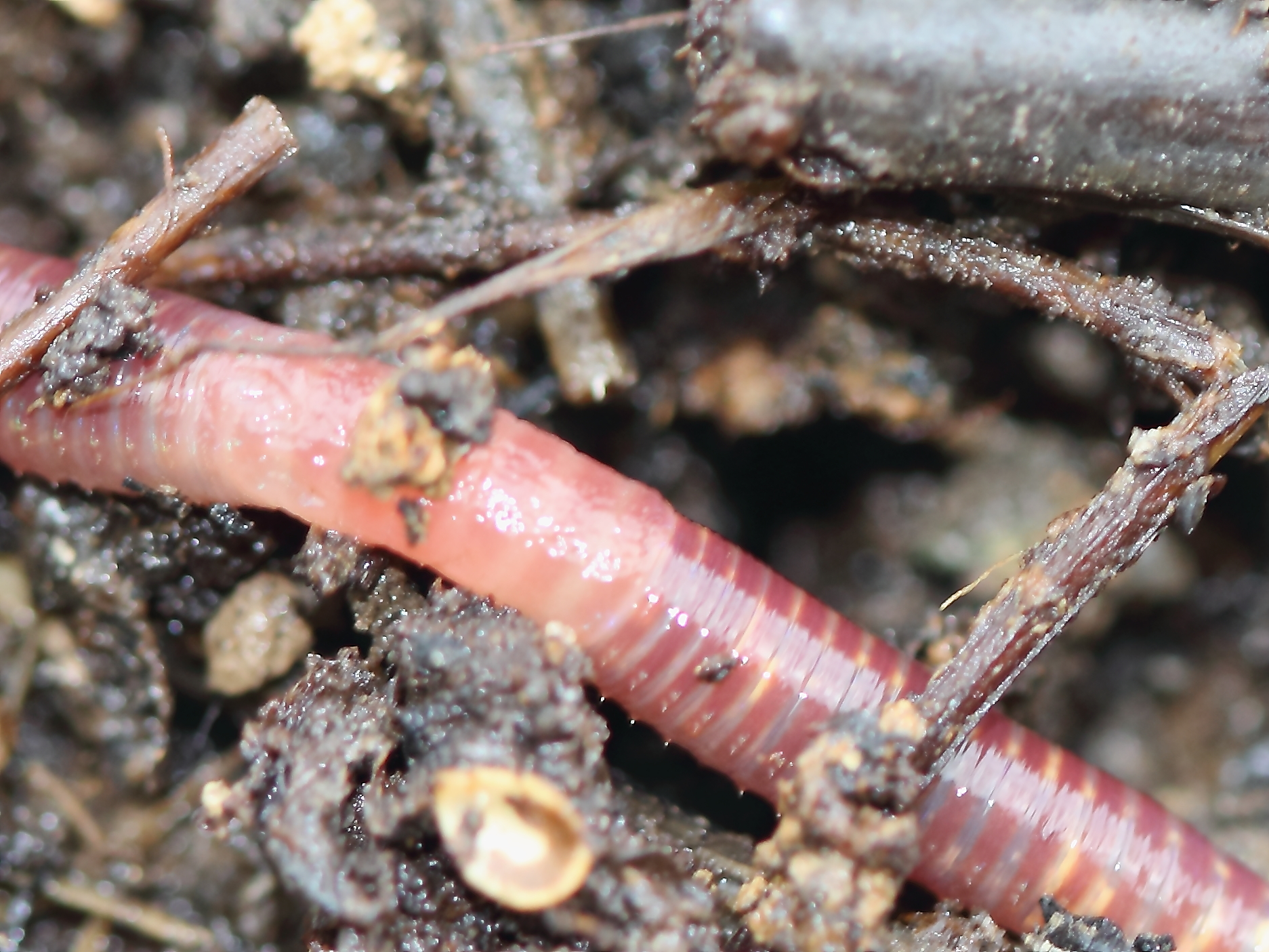
Eisenia fetida — the standard species used in vermicomposting bins. Photo: Wikimedia Commons / CC BY-SA 3.0
Stocking a worm bin correctly from the start avoids a class of problems that are otherwise difficult to trace — slow processing, incomplete breakdown, bin imbalances, and the frustration of a bin that never seems to be working. The core question is simple: how many worms per unit of food waste? The answer involves the worms' processing capacity, the temperature they're operating in, and what you're feeding them.
The Basic Stocking Ratio
The most widely cited starting ratio in vermicomposting literature is approximately 1 kilogram of worms for every 1 kilogram of food waste introduced per week. This is a conservative estimate that works across most household scenarios. It assumes food scraps of mixed composition — some wet, some dry — at a consistent weekly volume.
In practice, households starting a bin often stock lower and scale up as the population grows. A starting population of 0.5 kg (roughly 500–600 worms) can handle approximately 250–350 grams of food waste per week and will double in population over 3–6 months under good conditions, eventually reaching the processing capacity for the original 1:1 target.
Practical starting point for a Canadian household: Begin with 0.5 kg of red wigglers (available through Canadian composting suppliers and some garden centres). Feed no more than 200–300 g of food scraps per week for the first month. Increase feeding volume gradually as the population grows.
What Affects Processing Capacity
The 1:1 ratio assumes an average temperature of around 20°C and mixed household food scraps. Several factors shift this estimate:
Temperature
Red wigglers are cold-blooded. Their metabolic rate — and therefore their feeding and reproduction rate — drops significantly below 15°C. At 10°C, processing slows to a fraction of peak capacity. At temperatures near freezing, worms enter a low-activity state and may cluster in the warmest available zone of the bin.
Canadian households keeping bins in unheated basements or garages from November through March will see noticeably lower processing rates. The practical adjustment is to reduce feeding frequency rather than continuing to add food at summer rates, which leads to accumulation and odor.
Food Composition
High-nitrogen foods (fruit scraps, vegetable peels, cooked legumes) break down quickly and are processed faster. High-carbon items (cardboard, dry leaves, bread crusts) slow processing. A bin fed exclusively high-nitrogen waste will process faster but is more prone to odor and acidity issues. Balanced inputs are more predictable.
Particle Size
Worms have no teeth. They consume food that has begun to decompose or has been physically broken down. Smaller pieces — roughly 2–3 cm or less — are processed significantly faster than large chunks. Chopping or blending food scraps before adding them is not required, but it shortens the time between addition and consumption.

Active worm composting bin with visible worms and partially decomposed material. Photo: Wikimedia Commons / CC BY-SA 3.0
Stocking Rate by Bin Size
| Bin Size (approx.) | Starting Worm Weight | Weekly Food Input at 20°C | Weekly Food Input at 12°C |
|---|---|---|---|
| 30L (small bin) | 0.25–0.5 kg | 125–250 g | 60–125 g |
| 60L (medium bin) | 0.5–1.0 kg | 250–500 g | 125–250 g |
| 100L (large bin) | 1.0–2.0 kg | 500 g–1 kg | 250–500 g |
These figures are approximations based on published extension guidance and should be adjusted based on observed bin activity — specifically, whether previous food additions have been fully processed before the next feeding.
Bedding Refresh: When and How
Bedding in a vermicompost bin does not last indefinitely. Over time, bedding materials are consumed, compacted, and converted into castings. When the original bedding structure is largely gone and the bin is 60–80% castings, it is time to harvest and refresh.
How to Tell When Bedding Needs Refreshing
- The bin contents appear uniformly dark and granular with little visible original bedding material
- Processing appears to slow despite adequate moisture and temperature
- Worm population appears less dense than previously observed
- Odor has shifted from earthy to slightly sour or flat
For a mid-sized bin fed at moderate rates, full bedding replacement is typically needed every 3–6 months. Partial refreshes — adding new bedding to one side of the bin to encourage worm migration — can extend this interval and simplify harvest.
The Migration Method
The migration method avoids sorting worms from castings manually. Move all existing material to one side of the bin. Fill the empty side with fresh, moist bedding and a small amount of food scraps. Over 2–4 weeks, most worms will migrate toward the food. The original side can then be harvested with minimal worm loss.
Canadian-Specific Notes on Supplier Sourcing
Red wigglers (Eisenia fetida) are sold by a number of Canadian suppliers, including some garden centres and through online retailers that ship within provinces. Shipping worms in winter requires insulated packaging and is typically restricted to warmer months by most suppliers. Orders placed in spring (March–May) arrive when temperatures are suitable for safe transit.
If starting a bin in autumn or winter, sourcing from a local supplier or another vermicomposter is preferable to mail order during cold periods. Many Canadian composting groups and municipal composting programs occasionally distribute starter cultures — Toronto's green bin program, for example, has periodically organized community worm distribution events.
Overstocking: Signs and Correction
Overstocking occurs when the worm population exceeds the food supply's capacity to sustain it. Signs include worms trying to escape the bin in unusual numbers, reduced body weight of individual worms, and slower overall bin activity despite adequate moisture and temperature.
Correction involves either increasing feeding volume (if the bin has space and capacity) or dividing the population into two bins. Splitting a bin is also the natural result of a healthy, expanding population and is a normal milestone in household vermicomposting.
External References
Last updated: May 22, 2026